Wednesday, October 17, 2012

Добрый день дорогие друзя!  

I absolutely am enamored with Russian cooking and the rich savory dishes that come from Eastern Europe, so today, I wanted to share a classic recipe for Borsch (Борщ) with you.  To be fair, Borsch originated in Ukraine and is claimed very proudly by the Ukrainian people.  However, the Soviet Union, which Ukraine was a part of for most of the 20th century, disregarded regional identities for the more national identity, found in Moscow rather than your home region.  Because of this, Borsch came to be associated with Russia, and continues to be to the present day.

Traditionally, the carrots and beets are grated into the soup, although there about as many variations of Borsch as there are Russians and Ukrainians!  One thing you will find if you ever travel to Eastern Europe (particularly the republics of the former USSR), is that Borsch is absolutely a staple to the common diet of the people.  There are two varieties that are primarily cooked in Russia and Ukraine: green (зелёный) and red (красный) Borsch.  Green Borsch is traditionally prepared during the summer and red in the colder winter months.  Borsch is also traditionally eaten with garlic sauce soaked rolls called "Pampushki." Here, I have shared a great recipe for Borsch I discovered online that I highly recommend.  The only changes that I would recommend (although you can do whatever you like) is to grate the beets and carrots rather than chopping them, particularly if you are in a home of people who are apprehensive of beets!  The only two absolutes in the dish are allowing the beef broth to cool over night, (it really improves the quality of the soup by removing the fat from the broth) and you must use fresh Dill!  Dill is by far the most popular spice in Ukraine and Russia and you will find your food covered in it wherever you go!  The fresh Dill is by far what makes the dish.  I hope you enjoy cooking this as much as I did.  Cooking can be quite therapeutic :-)

Удачи и приятного аппетита!

 http://www.photo-dictionary.com/photofiles/list/4084/5476borsch.jpg
 

 Ingredients

  • 8 cups beef broth*
  • 1 pound slice of meaty bone-in beef shank
  • 1 large onion, peeled, quartered
  • 4 large beets, peeled, chopped
  • 4 carrots, peeled, chopped
  • 1 large russet potato, peeled, cut into 1/2-inch cubes
  • 2 cups thinly sliced cabbage
  • 3/4 cup chopped fresh dill
  • 3 Tbsp red wine vinegar
  • 1 cup sour cream
  • Salt and pepper to taste
*Use gluten-free broth if you are cooking gluten-free

Method

1 Bring 4 cups of the beef broth, the beef shank, and onion to boil in large pot. Reduce heat, cover, and simmer until meat is tender, about 1 hour 30 minutes.

2 Transfer meat to work surface; trim fat, sinew and bone and discard. Chop meat; cover and chill. Cool broth slightly. Chill in pot until cold, at least 4 hours and up to 1 day.

3 Spoon fat from top of chilled broth and discard. Add remaining 4 cups broth, beets, carrots, and potato; bring to boil. Reduce heat, cover, and simmer until vegetables are tender, about 30 minutes.

4 Stir in meat, cabbage and 1/2 cup dill; cook until cabbage is tender, about 15 minutes. Season to taste with salt and pepper. Stir in vinegar.
Ladle soup into bowls. Top with sour cream and remaining 1/4 cup dill.


Yield: Serves 6.

Friday, October 12, 2012

Apocalyptic Visions at Chernobyl - Terry Mattingly


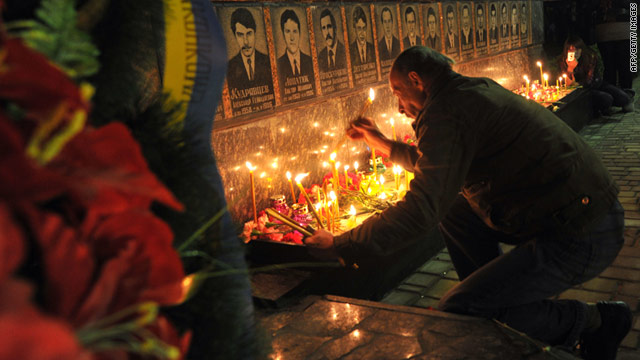
KIEV - The apocalyptic visions begin just inside the doors of the Ukrainian National Chernobyl Museum and many of them lead into the Book of Revelation.

The final pages of Christian scripture are full of angels, trumpets, flames, thunder, lightning, earthquakes and catastrophes that shake heaven and earth.

In this museum, the key is in the eighth chapter: "And the third angel sounded, and there fell a great star from heaven, burning as it were a lamp, and it fell upon the third part of the rivers, and upon the fountains of waters.  And the name of the star is called Wormwood: and the third part of the waters became wormwood; and many men died of the waters, because they were made bitter."

When Ukrainians translate "wormwood" into their own language it becomes "chernobyl." It's easy to connect the two when discussing the legacy of pain that followed the 1986 disaster at the Chernobyl Power Station north of Kiev, when explosions and fires at the reactor core released a plume of radioactive debris that drifted over Russia and into Europe.  Soviet officials claim a mere 31 died.  Ukrainians mock this number, saying it's impossible to calculate the long-term fallout in cancers, birth defects, and other forms of human suffering.

"The catastrophe at Chernobyl station took its victims before their time," said Archpriest Andrei Tkachev of St. Agapit of Pechersk Orthodox Church in Kiev. "Man is supposed to meet death in his own time, when he has a chance to prepare to meet God.  That kind of death is a gift from God - a good death."

"That is not what happened for many of the vicitims of Chernobyl."

The museum opened on April 26, 1992, the sixth anniversary of the disaster and soon after the Soviet Union's collapse.  The exhibits include 7,000 artifacts from the 76 towns and villages- with 76 churches, in this historically Orthodox culture - that were razed in the radiation-tainted resettlement zone.

The door into a large chamber dedicated to the families and children of Chernobyl leads to the church iconostasis, with a radiation suit hanging in place of the Archangel Michael and barbed wire and a contamination sign blocking the way to the altar.  High overhead is an icon of St. Nicholas, the patron saint of endangered children.  The altar is gone, replaced by a boat - to carry souls over the waters of death - full of children's toys.  Under the boat, the blackness is full of the icons of the saints.

The Chernobyl disaster was especially poignant, said Tkachev, because it struck a region that for many symbolized the innocence and safety of the past. "The people here were simple people.  They didn't have writers and journalists to tell their stories," he said. "This is an attempt to tell their story, using what they left behind when they were forced to flee the homes, their schools and their churches. ...

"Modern life separates a man who has deep faith from a man who has little.  In these villages, life and faith were simply combined and you can see that here." In one of the starkest images - over a map of the stricken region - the melting reactor literally shatters a famous icon of the Virgin Mary holding the Christ child, while an apocalyptic storm swirls around her.

"We are tempted to think that fire and water and all the elemnts of nature are at our command, but that is not true," said Tkachev, outside the final exhibit hall. "We can become victims. ... The more technologies are in our lives, the more danger there is that we become their servants, even their slaves." The archpriest stroked his beard, thinking of another way of stating the ultimate message of this sobering tribute to lessons learned at Chernobyl.

Finally he offered a litany of simple images. "If a man builds a bicycle and it breaks while he is riding it, then he will be hurt when he falls," said Tkachev. "If he builds an airplane and it breaks, he will almost certainly die when it crashes.  Now, if we build a nuclear reactor in our backyard and it breaks, then the catastrophe will kill many and it may last into future generations," he said. "What this teaches us is that we must fear God and try to be humble about the things that we build with our
own hands."


________________________________________________________________________________

Terry Mattingly is the director of the Washington Journalism Center at the Council for Christian Colleges and Universities and leads the GetReligion.org project to study religion and the news.